
If you’ve ever worked in tech, you know the drill. Something breaks in production, a gap in documentation, a flaw in the system, and you don’t rebuild from scratch. You deploy a patch. You fix what’s broken, you reinforce what’s vulnerable, and you keep the system running.
Medieval scribes were doing exactly this, 700 years before anyone coined the term “hotfix.” And honestly, the way they went about it would make any Elven bookbinder in Rivendell proud.
When parchment was your production environment
Parchment, made by soaking animal skin in lime, stretching it onto a frame, and scraping it razor-thin with a curved blade called a lunellum, was the standard medium for recording knowledge from roughly the 5th to the 13th century. It was extraordinarily labour-intensive to produce and enormously expensive to replace. A single book could require the skins of an entire flock.
And just like any production environment, things went wrong. The parchment maker’s knife would slip, cutting too deep and leaving holes. The animal’s own skin imperfections (scars from fights, follicle damage, uneven thickness) would stretch into gaps as the hide was tensioned on the frame. By the time a sheet reached the scribe’s desk, it might already have vulnerabilities. Sound familiar?
Patching, medieval style
Here’s what fascinates me: the scribes didn’t discard imperfect parchment. They couldn’t afford to. Instead, they patched it, and they did so with a sophistication that feels remarkably modern in its logic.
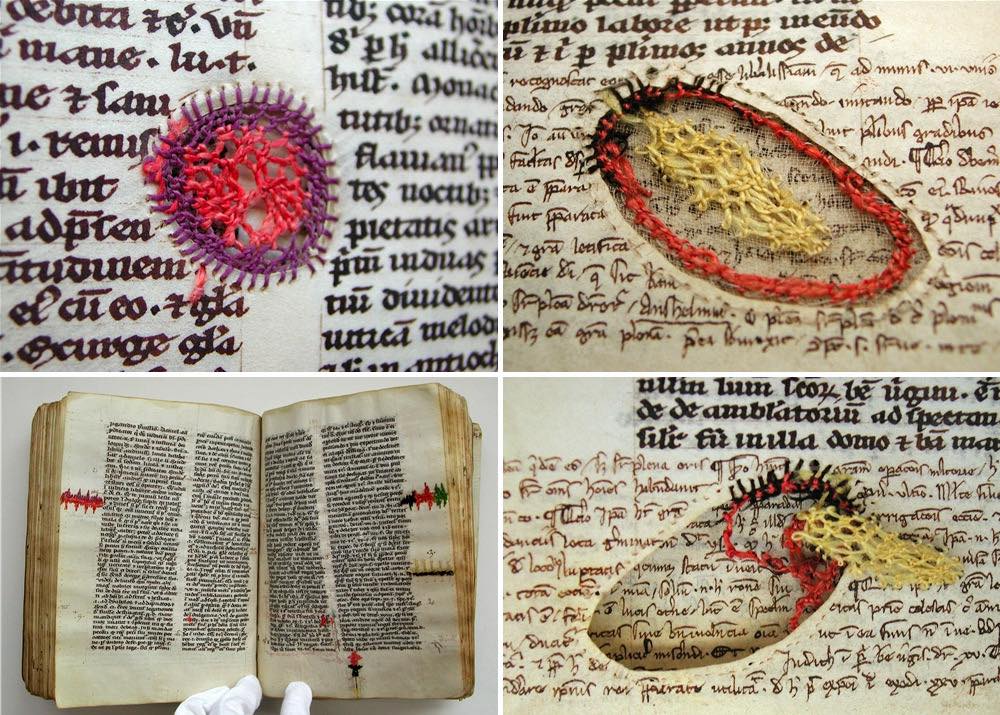
Using coloured silk thread and techniques like buttonhole stitch, they would carefully close tears and fill holes before any text was written on the page. Some of these repairs were functional and minimal, what Christine Sciacca of the Walters Art Museum has jokingly called “Frankenstein” repairs. Others were intricate, decorative, and vibrant: rainbow-hued silk stitching in pinks, greens, purples, and yellows that transformed a flaw into an embellishment. Think less crude battlefield stitching and more the kind of meticulous craft you’d expect from the Grey Havens.
At the Engelberg Abbey library in Switzerland, 12th-century manuscripts show silk repairs so technically sophisticated that textile historians now consider them an early form of needle lace, predating what was previously thought to be a 16th-century Italian invention by some 400 years.
And at Germany’s Bamberg State Library, one scribe took a different approach entirely: he drew a bearded, laughing man around three holes in the parchment, turning the gaps into an eye, a nose, and a wide-open mouth. A bug became a feature. Somewhere, a D&D dungeon master is nodding approvingly.
The patch philosophy
What strikes me most about these repairs is not just the craftsmanship, but the underlying philosophy, one that maps almost perfectly onto how we think about knowledge system maintenance today.
Patch before you build. The silk repairs were done before the scribe wrote a single word, just as we deploy patches before pushing new features onto a fragile foundation.
Don’t hide the fix, make it part of the system. These repairs weren’t concealed. The bright colours suggest the repairers had no inclination to disguise their work. There’s something of the Japanese kintsugi philosophy here: acknowledge the break, mend it with care, and let the repair become part of the object’s story. Gandalf didn’t try to hide the cracks in his staff after facing the Balrog. Sometimes the mend tells its own tale.
Preservation is an ongoing practice, not a one-time event. At the Morgan Library in New York, a 13th-century sacramentary shows evidence of repairs made at different times, some by the original parchment maker, others by the monastic community that used the book for decades. Knowledge maintenance is never “done.” It’s a long-running campaign, not a one-shot quest.
The real lesson
Every knowledge manager I know has inherited a system with holes in it. Gaps in documentation, broken links, outdated content, processes that no longer match reality. The temptation is always to start fresh: a new platform, a new taxonomy, a migration to the shiny new tool. The classic “burn it all down and rebuild from the ashes” approach. Very Sauron. Not recommended.
But sometimes the wisest approach is the oldest one. Assess the damage. Patch what’s broken. Reinforce what’s weak. And if you can make the repair beautiful, clear, well-structured, even elegant, so much the better.
Medieval scribes understood something that we keep having to relearn: the most valuable knowledge systems aren’t the ones that were perfect from the start. They’re the ones that were worth repairing.
After all, even the smallest stitch can change the course of a great story.
Marcela Gleixner writes about knowledge management, content strategy, and AI at knowledgemanagement.ie.
The original patch: what medieval silk thread can teach us about knowledge maintenance
If you’ve ever worked in tech, you know the drill. Something breaks in production, a gap in documentation, a flaw in the system, and you don’t rebuild from scratch. You deploy a patch. You fix what’s broken, you reinforce what’s vulnerable, and you keep the system running.
Medieval scribes were doing exactly this, 700 years before anyone coined the term “hotfix.” And honestly, the way they went about it would make any Elven bookbinder in Rivendell proud.
When parchment was your production environment
Parchment, made by soaking animal skin in lime, stretching it onto a frame, and scraping it razor-thin with a curved blade called a lunellum, was the standard medium for recording knowledge from roughly the 5th to the 13th century. It was extraordinarily labour-intensive to produce and enormously expensive to replace. A single book could require the skins of an entire flock.
And just like any production environment, things went wrong. The parchment maker’s knife would slip, cutting too deep and leaving holes. The animal’s own skin imperfections (scars from fights, follicle damage, uneven thickness) would stretch into gaps as the hide was tensioned on the frame. By the time a sheet reached the scribe’s desk, it might already have vulnerabilities. Sound familiar?
Patching, medieval style
Here’s what fascinates me: the scribes didn’t discard imperfect parchment. They couldn’t afford to. Instead, they patched it, and they did so with a sophistication that feels remarkably modern in its logic.
Using coloured silk thread and techniques like buttonhole stitch, they would carefully close tears and fill holes before any text was written on the page. Some of these repairs were functional and minimal, what Christine Sciacca of the Walters Art Museum has jokingly called “Frankenstein” repairs. Others were intricate, decorative, and vibrant: rainbow-hued silk stitching in pinks, greens, purples, and yellows that transformed a flaw into an embellishment. Think less crude battlefield stitching and more the kind of meticulous craft you’d expect from the Grey Havens.
At the Engelberg Abbey library in Switzerland, 12th-century manuscripts show silk repairs so technically sophisticated that textile historians now consider them an early form of needle lace, predating what was previously thought to be a 16th-century Italian invention by some 400 years.
And at Germany’s Bamberg State Library, one scribe took a different approach entirely: he drew a bearded, laughing man around three holes in the parchment, turning the gaps into an eye, a nose, and a wide-open mouth. A bug became a feature. Somewhere, a D&D dungeon master is nodding approvingly.
The patch philosophy
What strikes me most about these repairs is not just the craftsmanship, but the underlying philosophy, one that maps almost perfectly onto how we think about knowledge system maintenance today.
Patch before you build. The silk repairs were done before the scribe wrote a single word, just as we deploy patches before pushing new features onto a fragile foundation.
Don’t hide the fix, make it part of the system. These repairs weren’t concealed. The bright colours suggest the repairers had no inclination to disguise their work. There’s something of the Japanese kintsugi philosophy here: acknowledge the break, mend it with care, and let the repair become part of the object’s story. Gandalf didn’t try to hide the cracks in his staff after facing the Balrog. Sometimes the mend tells its own tale.
Preservation is an ongoing practice, not a one-time event. At the Morgan Library in New York, a 13th-century sacramentary shows evidence of repairs made at different times, some by the original parchment maker, others by the monastic community that used the book for decades. Knowledge maintenance is never “done.” It’s a long-running campaign, not a one-shot quest.
The real lesson
Every knowledge manager I know has inherited a system with holes in it. Gaps in documentation, broken links, outdated content, processes that no longer match reality. The temptation is always to start fresh: a new platform, a new taxonomy, a migration to the shiny new tool. The classic “burn it all down and rebuild from the ashes” approach. Very Sauron. Not recommended.
But sometimes the wisest approach is the oldest one. Assess the damage. Patch what’s broken. Reinforce what’s weak. And if you can make the repair beautiful, clear, well-structured, even elegant, so much the better.
Medieval scribes understood something that we keep having to relearn: the most valuable knowledge systems aren’t the ones that were perfect from the start. They’re the ones that were worth repairing.
After all, even the smallest stitch can change the course of a great story.
Marcela Gleixner writes about knowledge management, content strategy, and AI at knowledgemanagement.ie.